What is TASA iSPARK? Inside Taiwan's New Space Startup Accelerator
TASA iSPARK is Taiwan’s new space startup accelerator. See how its three engagement tiers work and why SATELYX joined as a co-creation partner.
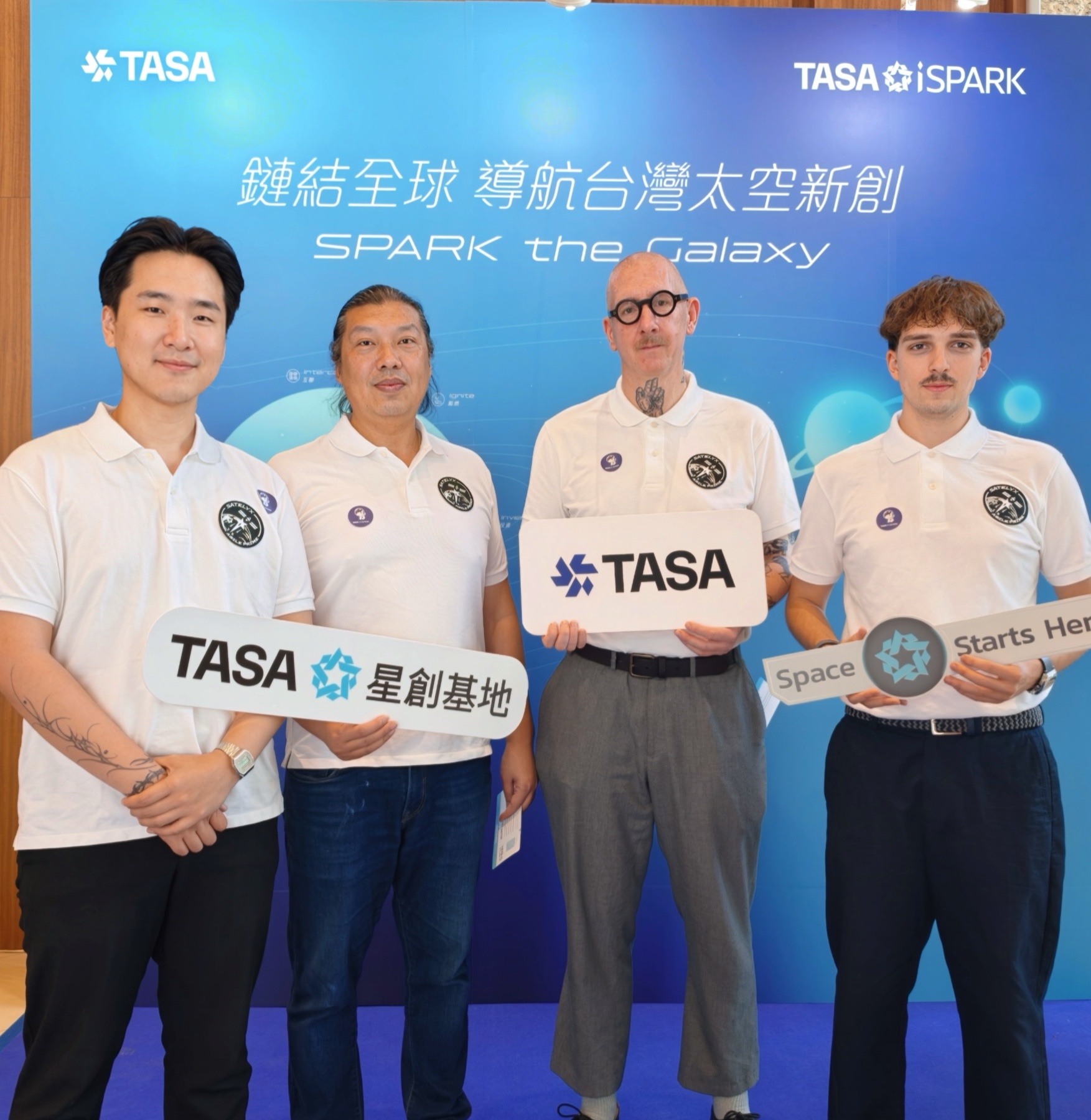
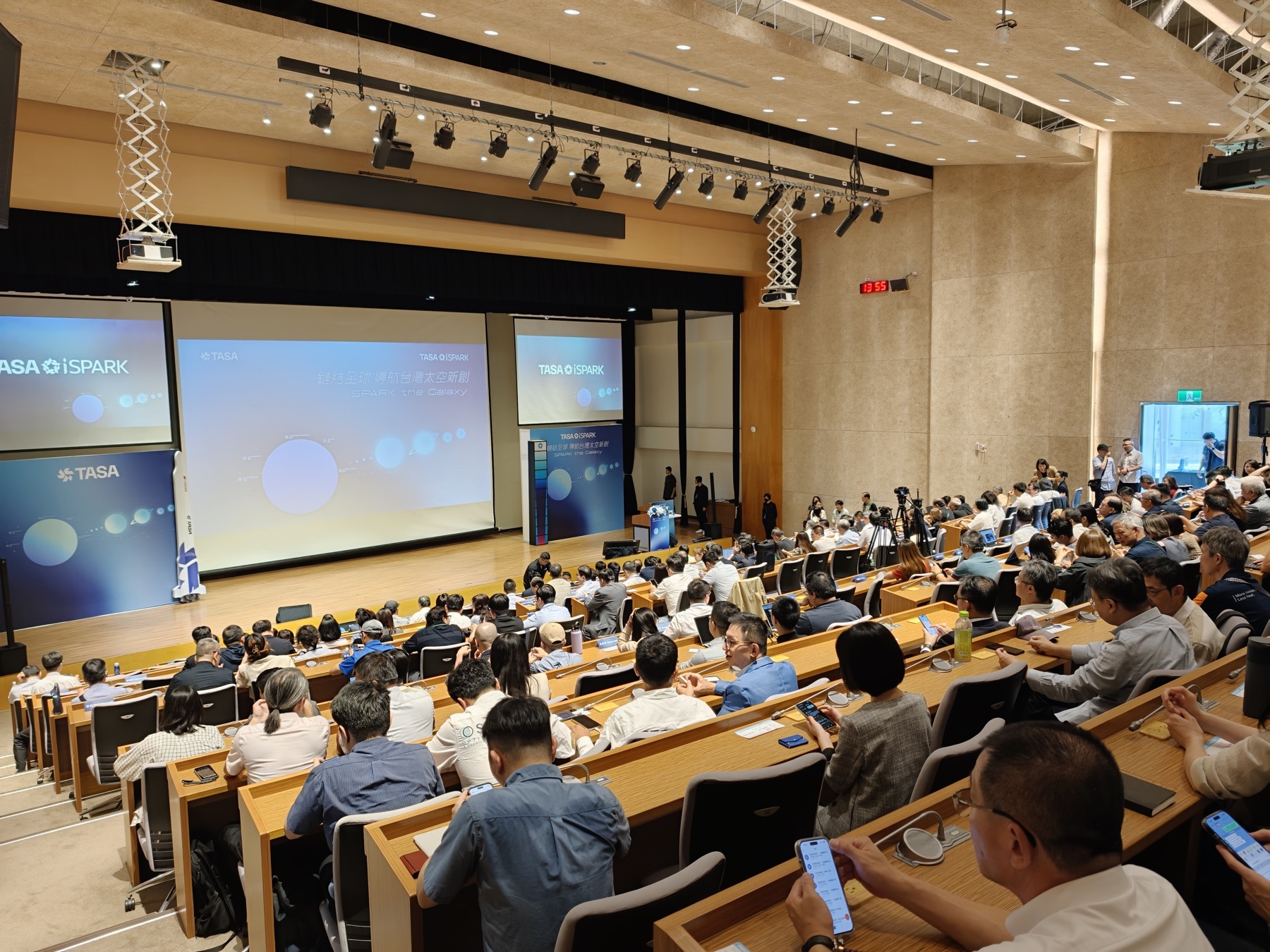
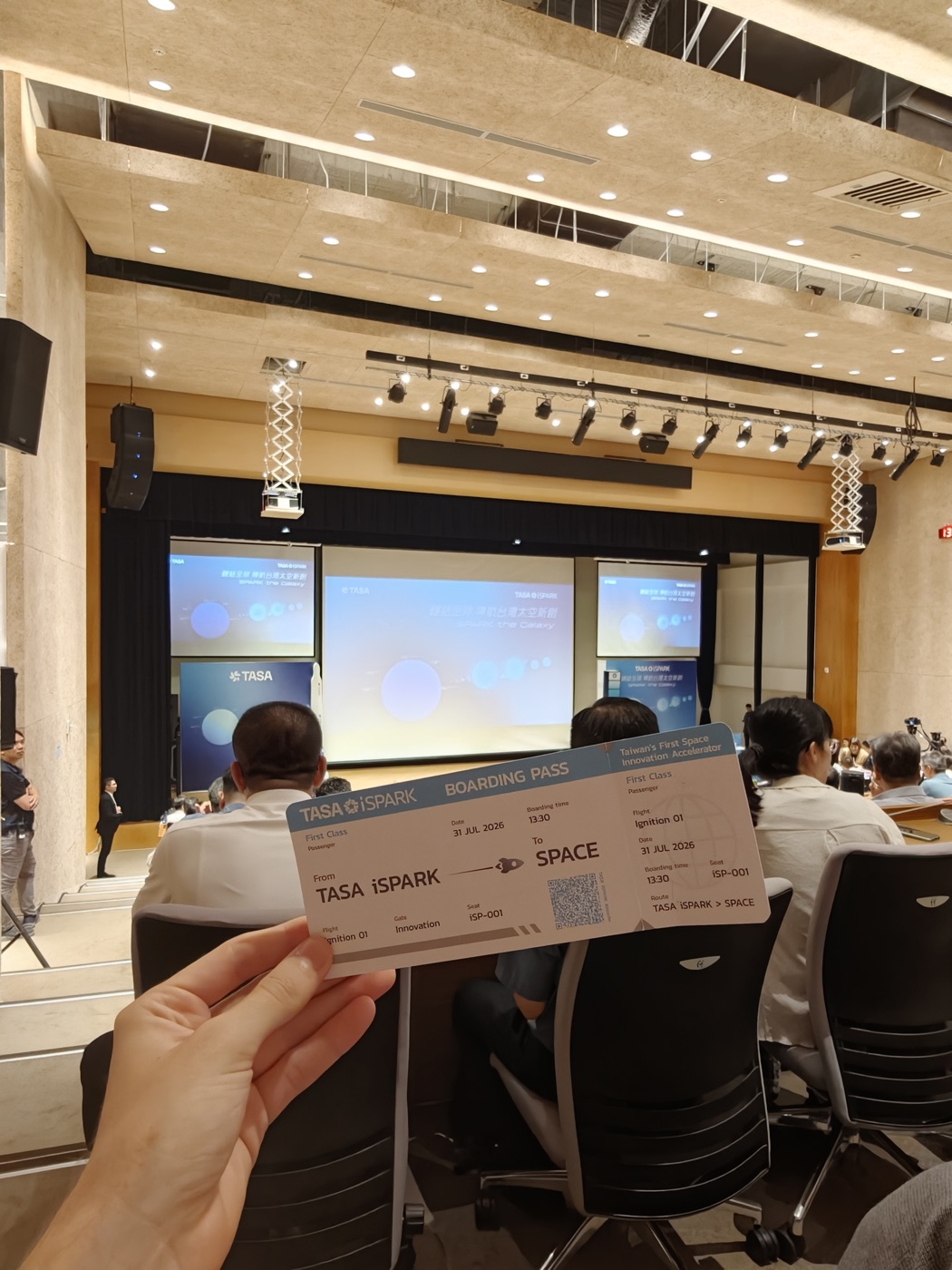
On 31 July 2026, the Taiwan Space Agency (TASA) opened TASA iSPARK (星創基地), which the agency describes as the first accelerator of its kind in Taiwan dedicated to the space industry. The opening took place at Xianqi Hall on the Boai campus of National Yang Ming Chiao Tung University (國立陽明交通大學) in Hsinchu, a few minutes from both TASA’s own headquarters and the Hsinchu Science Park.
In TASA’s own framing, iSPARK exists to connect research, industry, investment and international linkages, and to help startup teams cross the threshold between technology development and market application. That threshold is the specific problem we work on at SATELYX, which is why we are involved as a co-creation partner.
Premier Cho Jung-tai (卓榮泰) opened the ceremony, describing iSPARK as the first government-backed space startup accelerator in Taiwan and saying he hoped it would become an important hub connecting Taiwan to the international space industry. He was joined by National Science and Technology Council Minister Wu Cheng-wen (吳誠文), TASA Director General Wu Jong-Shinn (吳宗信), Legislator Ker Chien-ming (柯建銘), and Hsinchu Deputy Mayor Lin Kun-han (林琨瀚). The programme itself was presented by Evin Liao (廖榮皇), Director of TASA’s Space Industry Promotion Division and concurrently iSPARK’s Executive Director.
The opening ran under the theme “SPARK the Galaxy: Connecting the world, navigating Taiwan’s space startups,” and our team was in the room.
What TASA iSPARK Is
Taiwan has been running a national space programme since the early 1990s, and its semiconductor and precision manufacturing base is older still. iSPARK exists to connect those two things commercially, by taking companies that can already manufacture to an extremely high standard and giving them a route into space supply chains.
TASA positions iSPARK as “an Asian gateway for space innovation, market-oriented at its core, combining technology validation with international linkage.” The mechanism it names for that is co-creation in a specific sense: established companies pose the problem, startups solve it (企業出題、新創解題), which is a more concrete definition of the word than most accelerators offer.
International connection is not a side feature of the programme, it is most of the stated point. Premier Cho’s formulation was that innovation cultivation, industry linkage and international cooperation have to work together for Taiwan to hold its footing internationally in next-generation communications and space. iSPARK is the instrument TASA has built for that combination, and nearly every element of it points outward, from the overseas market tracks to the mentor network to the co-creation partner tier itself.
The scale of the commitment behind it is substantial. The Third Phase National Space Technology Long-Term Development Programme commits more than NT$71 billion across legislation, organisation, policy and budget. iSPARK is the part of that effort aimed at new companies rather than at existing agency programmes.
The strategy behind that number is not really about launching more satellites. In TASA’s account of the opening, Premier Cho framed next-generation communications as the key route for Taiwan to reach international markets and lift its competitiveness, and placed it inside both the Ten Major AI Infrastructure Projects and the list of key strategic industries. The argument made repeatedly from the stage was that Taiwan should extend what it is already very good at, semiconductors, AI and precision manufacturing, into space, rather than trying to build a space sector out of an agency budget alone. Whoever supplies satellite communications ends up supplying the ground stations, the user terminals, and eventually the vehicles and devices that connect through them, which is where the market actually sits.
The facility itself is deliberately modest, with seven independent offices and a set of shared desks, meeting space and a demo area. Liao was direct about this during his presentation, saying the point is the platform rather than the floor space, and four of the seven offices had already been taken by the day of the opening.
The teams already in residence work in satellite communications, optics and remote sensing, test and validation, ground equipment, AI applications, advanced materials and system integration. Around them sits a co-creation network spanning electronics manufacturing, satellite services, testing and validation, investment, legal and professional advisory.
Why Hsinchu
Hsinchu is where Taiwan’s first science park opened in 1980, and it remains the centre of Taiwan’s semiconductor industry. Placing a space accelerator inside that cluster, next door to TASA and on a university campus, is the whole thesis in one decision.
The practical effect for a resident company is that the test and verification loop runs faster than it would anywhere else, because the agency that performs the validation is a short walk away rather than a procurement cycle away. That proximity was raised repeatedly during the opening as iSPARK’s clearest structural advantage.
Taiwan’s Space Industry, In Five Layers
Liao’s presentation set out a five-layer view of where Taiwanese companies can participate, and it is a useful map whether or not you are based in Taiwan.
Infrastructure. Next-generation communications, the space-to-ground connectivity layer, and eventually domestic launch capability.
Satellite bus and platform. Communications, remote sensing and dual-use platforms. The argument here is that Taiwan needs a domestic standard bus so that new technology can be refreshed quickly, and TASA has spent the last one to two years helping Taiwanese firms develop an expanded bus toward that end.
Space-grade components off the semiconductor base. This is the layer where Taiwan’s existing advantage is most direct. Commercial space no longer requires a bespoke chip developed over a decade, so a commercial IC with radiation-tolerant design work and the right testing can qualify for orbit. Automotive electronics components were named specifically as a category that can make this transition.
Ground equipment. Roughly 95% of Taiwan’s annual satellite-related output value sits here, and most of it is contract manufacturing for overseas companies. Moving those firms from contract manufacturing toward their own designs and brands is an explicit goal of the programme.
Satellite applications. The largest share of the international market and, by Liao’s own assessment, historically Taiwan’s weakest layer. It is also the lowest-capital layer, which is why he named it as the most likely place for Taiwan’s first space unicorn to appear.
The Three Ways to Engage
This is the part most people get wrong, because they assume an accelerator only has one door.
Physical residency (實體進駐). The conventional route, for startups that want desk space on site, typically for one to two years.
Virtual residency (虛擬進駐). No physical space at all. A company joins the programme for the workshops, the mentoring and the international tracks, including the United States market-entry and public-listing curriculum. This tier exists because a company does not need to occupy a desk in Hsinchu to benefit from the network attached to it.
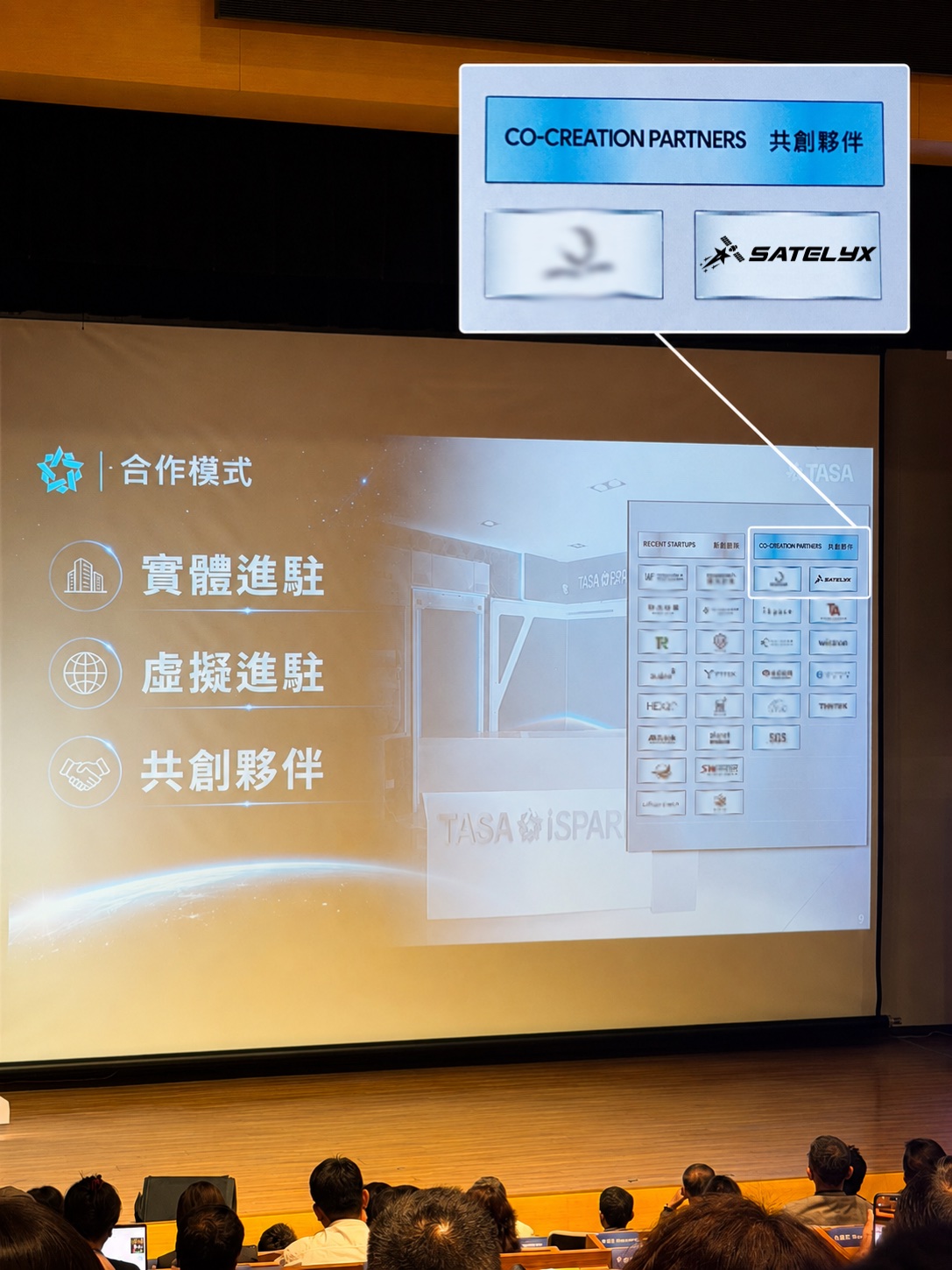
Co-creation partner (共創夥伴). The tier for organisations that are not startups. A company of any size that brings a capability the resident startups need can join as a partner rather than as a participant. Liao framed it explicitly as give-and-take: the partner brings market access, technical depth or commercial experience, and gains early visibility of emerging technology, with joint ventures and investment as downstream possibilities.
SATELYX sits in the third tier. We are not being incubated by iSPARK, we work alongside it.
The New TASA Validation Certification
TASA also used the opening to announce a space-grade mission validation certification, open to companies that have worked with the agency. The stated purpose is to give a company a national endorsement it can carry into international business, rather than asking it to establish credibility from scratch in every new market.
The scope covers satellite manufacturing, launch, the ground segment, applications and space sustainability. For the component manufacturers in layer three of the model above, this is the mechanism that turns an existing terrestrial product into something an overseas satellite programme will consider.
International Routes
iSPARK launched its international programme this year in partnership with Asia Innovation Hub (AIH), built around teaching from international mentors, overseas market exploration and supply-chain introductions, with the stated aim of getting Taiwanese space startups into international space supply chains. The programme sits alongside one-to-one mentor matching, industry courses, co-creation workshops and matchmaking events.
At the opening, Nicola Corzine, CEO and Executive Director of the Nasdaq Entrepreneurial Center, gave a recorded address setting out what she looks for in companies entering the United States market.
Her advice was practical rather than promotional, and it applies well beyond Taiwan. Build a presence in the market you are raising in, because investors back people they can reach. Secure an early customer relationship, since a letter of intent or a co-development agreement carries more weight than any deck. Treat export control as a founding-stage question rather than a late-stage checkbox. And connect your national strength to your specific story, which for Taiwanese companies means linking precision manufacturing depth and engineering culture to what you are building in space.
On public listing she was notably cautious, describing it as a financing instrument used at a particular moment rather than a destination, and pointing to the 2020 and 2021 listing wave as evidence of what happens when companies go public before they have durable revenue.
What SATELYX Does
SATELYX is an Agile Prime for responsive space, which means we validate space technology in orbit and turn what works into a catalog of flight-proven capability that companies and government customers can deploy quickly.
SATELYX is a UK company with operations and commercial activity across Asia-Pacific, supported by a distributed team and regional partner network. Our team is distributed across the UK, Portugal, Taiwan and Japan.
Space ecosystems develop different strengths, and much of the useful work lies in connecting them. Taiwan brings manufacturing depth, precision and supply-chain maturity. SATELYX helps technology companies connect those strengths to overseas customers, agencies, investors and a managed route to flight validation.
That makes the useful direction of travel a two-way one, which is the part people usually miss. Taiwanese technology needs investors, agencies and customers in markets like the UK, Europe and Japan, and companies in those markets need exactly the manufacturing depth Taiwan has, which is very often the piece of their own supply chain they cannot build at home.
There is a direct technical overlap too. SATELYX can deploy its own edge-compute infrastructure alongside customer payloads, giving software teams a controlled platform and deployment path for onboard processing. Partners run their own software on that infrastructure; SATELYX does not build their applications.
That last point is the core of the model. By factoring multiple partners’ technologies into one shared mission, SATELYX creates a managed route to flight evidence. Successful results become documented, flight-proven capability. Catalog inclusion and any reuse of partner technology remain subject to the relevant agreement.
Why This Matters If You Are Not in Taiwan
The instinct when reading about a national accelerator is to assume it is closed to outsiders. iSPARK’s structure says otherwise, and that is the most useful thing about it.
The virtual residency and co-creation partner tiers exist precisely so that organisations without a Taiwanese presence can participate. For a company outside Taiwan, the programme is a route into one of the strongest manufacturing bases in the world, at the moment that base is deliberately turning toward space. For a company inside it, the partner network is a route out to markets that are otherwise slow and expensive to enter.
Both directions are the same bridge, and building that bridge is why we are involved.
If you build space technology and want to understand what a validation mission would look like for it, or if you are working on connecting a national ecosystem into international space supply chains, we are happy to talk. Reach us at [email protected].
TASA iSPARK is operated by the Taiwan Space Agency. Details in this article are drawn from the opening ceremony on 31 July 2026 and from TASA’s own announcement of the opening.
Does Your Space Technology Need Flight Evidence?
Start with a mission-fit review for the software or hardware you need to prove in orbit.
Request a mission review