How Satellite Payload Integration Works
See how satellite payload integration moves from objectives and interfaces through verification, combined testing, operations and flight evidence.
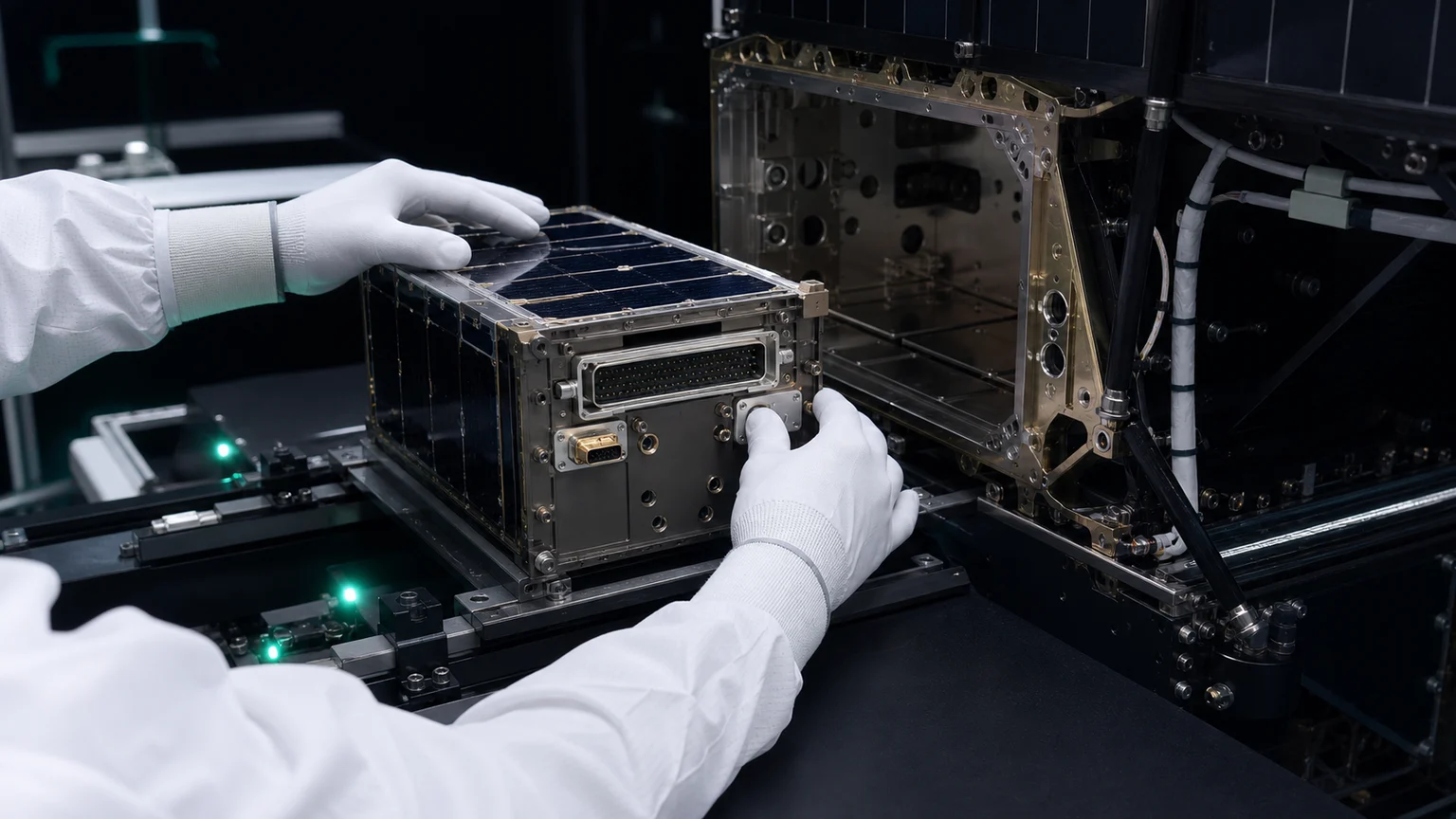
A satellite payload is ready to integrate when its flight objective, configuration, interfaces, verification evidence and operating plan agree. Payload integration is the controlled path that connects those decisions to the spacecraft, combined testing, flight operations and the resulting evidence.
By the time hardware reaches a cleanroom, the team should have controlled most integration decisions. The objective, configuration, interfaces and verification evidence shape the physical work, and the job continues through flight operations and delivery of the resulting evidence.
This guide explains that path after a candidate mission has been identified. If you are deciding what technical material to assemble first, start with the payload preparation guide.
The process follows the evidence objective
Integration begins with the question the flight must answer. A mission intended to observe functional operation needs a different campaign from one intended to measure accuracy, endurance, environmental response or performance across operating modes.
Define the objective, success criteria and evidence outputs before locking the integration approach. They determine which functions must be commanded, which data must be collected and which spacecraft resources and operational conditions matter.
This also prevents a common mismatch: integrating a payload successfully, then discovering that the available telemetry or mission timeline cannot support the intended claim.
1. Define the candidate configuration and concept of operations
The mission team needs an identifiable configuration to assess. For hardware, that may include the unit, revision, materials, components and mounting concept. For software, it includes the build, dependencies, runtime, parameters and update route.
The concept of operations describes how that configuration is expected to behave through the mission. It covers states such as launch, deployment, commissioning, demonstration runs, standby, reset, safe response and end of operations where relevant.
These are connected decisions. A mode that exists in a software diagram may require power, thermal conditions, communications, storage or spacecraft pointing that the mission cannot provide at the same time. Finding that conflict early is far easier than resolving it after physical integration.
2. Turn assumptions into controlled requirements and interfaces
Payload teams often begin with a mix of requirements, estimates and open questions. Integration turns that material into a controlled basis for decisions.
Requirements state what must be achieved and how compliance will be shown. Interface data explains how the payload and spacecraft interact. Depending on the technology, that covers:
- mechanical envelope, mounting, mass properties and alignment;
- power quality, consumption, connectors, grounding and bonding;
- thermal paths, temperatures and operating duty cycle;
- command, telemetry, timing, data rates and storage;
- software services, protocols, dependencies and update controls;
- electromagnetic compatibility and radio-frequency behaviour;
- operational states, inhibits, fault response and safety constraints;
- ground handling, transport, access and environmental controls.
The ECSS technical requirements specification standard sets out characteristics for technical requirements, while the ECSS interface management standard covers identifying, specifying, approving, controlling, implementing, verifying and validating interfaces through the lifecycle.
Teams may use an interface requirements document, an interface control document or another agreed structure. The name matters less than having one controlled source for each decision, owner and status.
3. Assess accommodation and compatibility
Accommodation asks whether the candidate payload can fit the mission as a system, not merely whether its outer dimensions fit a volume.
The assessment compares the payload’s needs with the spacecraft and mission constraints across mechanical, electrical, thermal, data, communications, software, safety and operations domains. Interactions matter. A higher duty cycle may affect power and thermal margins, while a new data mode may change storage, downlink and operations planning.
Compatibility work also identifies what is fixed, what can be adapted and what remains open. A finding may lead to a payload change, an interface adapter, a software service, a revised operating mode, a different verification method or a conclusion that the current mission is not a fit.
For a shared mission, this assessment must also consider the effects between payloads and the resources needed by the spacecraft as a whole. Acceptance cannot be inferred from one interface in isolation.
Plan isolation and fault containment
A shared spacecraft also needs a clear answer for what happens when a payload behaves unexpectedly. The integration review should identify how faults are detected, how the payload can move to a safe state or be disabled, and how power, commands, software and data paths prevent one payload from disrupting the spacecraft or another payload.
The right controls depend on the technology and mission. They may involve electrical protection, command authority, software boundaries, inhibits, monitoring or operational procedures. The verification plan should cover the chosen controls and the expected recovery path without assuming one architecture for every payload.
4. Agree the verification approach
Once the requirements and interfaces are stable enough, the parties agree how each relevant point will be verified. The methods include test, analysis, inspection, review of design or a combination chosen for the requirement and risk.
The ECSS verification standard treats verification as a planned programme tied to requirements, strategy and records. The ECSS testing standard covers ground test programmes and recognises qualification, acceptance and protoflight approaches. NASA’s payload test requirements likewise describe a baseline that is tailored to the payload, hardware and mission.
There is no universal list of tests or gates for every satellite payload. The agreed route depends on the design, existing evidence, changes from a previously tested configuration, mission environment and risk allocation. SATELYX reviews the available evidence and helps define the mission-specific verification and integration path. Responsibility for each analysis, test and facility is allocated case by case in the mission plan.
5. Close payload-level evidence before delivery
Before combined integration, the payload team normally needs to close the evidence assigned at payload level and record the accepted configuration.
Depending on the agreed scope, the package includes drawings, analyses, software records, inspection results, qualification or acceptance reports, calibration information, waivers and open-item status. Evidence from an earlier unit or mission needs a clear similarity argument. A familiar product name is not enough if the design, components, software or use have changed.
Configuration control is especially important for software. The flight build, parameters and dependencies should be traceable, and any update after acceptance should follow the agreed change process. The ECSS software engineering standard places software work within the broader system lifecycle rather than treating it as a separate late-stage upload.
6. Receive and integrate the payload
Delivery begins with confirmation that the received item and its records match the accepted baseline. Receiving checks cover the applicable identity, condition, cleanliness, connector protection, transport data, configuration and documentation.
Physical integration then follows controlled procedures. Depending on the design, it includes mounting, harness connection, bonding, alignment, software loading and controlled functional checks. Each step preserves configuration and records discrepancies.
NASA’s product integration guidance describes integration inputs such as specifications, drawings, interface documentation and plans. It also calls for integration in the planned sequence, confirmation against interface requirements and records of anomalies and configuration. The principle is directly useful: combined hardware should be built from controlled inputs, not from memory or workshop assumptions.
7. Verify the combined system and close anomalies
A payload that works alone can still fail to work as part of the spacecraft. Combined checks examine the interfaces and mission functions that only exist after integration.
Combined checks typically cover electrical continuity, communications, command and telemetry paths, time synchronisation, mode transitions, data handling, fault response and end-to-end operations. The exact set is mission-specific. Environmental work may also be performed at an integrated level when assigned by the verification plan.
An unexpected result should enter a controlled anomaly process. The team records the event and configuration, assesses impact, identifies corrective action and repeats the relevant verification where needed. Closing the paper trail matters as much as correcting the immediate symptom because the final evidence must show which state actually flew.
8. Establish the accepted flight configuration
Acceptance is a decision based on the mission’s agreed requirements, evidence, open risks and authorities. It is not automatic because a payload completed a test campaign or was physically installed.
Before flight, the parties should know the accepted hardware and software baseline, remaining limitations, approved waivers, operational constraints and ownership of outstanding actions. Procedures and ground systems should refer to the same configuration.
The names of reviews and release gates vary between programmes. What matters is a controlled decision that connects the technical evidence to the article and operations planned for flight.
9. Prepare operations and evidence delivery
Integration is incomplete if the spacecraft can command the payload but the mission cannot answer the original question.
The operations plan translates the evidence objective into command sequences, modes, timing, data products, health monitoring, anomaly response and downlink priorities. Telemetry definitions and processing should be stable enough that the team can connect measurements to the correct configuration and operating context. The ECSS telemetry and telecommand standard is one formal reference for packet use within space missions.
After flight operations, the mission record should link the configuration, timeline, telemetry, logs, anomalies and results against the success criteria. The guide to credible flight evidence explains how that package supports a bounded heritage claim and a later buyer decision.
Integration is iterative, but it should stay controlled
The numbered sequence is a useful map, not a universal set of gates. Payload and spacecraft teams often revisit earlier decisions as evidence arrives, interfaces mature or mission constraints change.
Revisiting a decision is normal. The important point is to carry each change through the affected requirements, interfaces, verification records, configuration and operating procedures, instead of leaving the final decision buried in email.
How the process works in a SATELYX mission
Within IOD as a Service, SATELYX is an Agile Prime for responsive space, responsible for mission integration from the candidate configuration through combined verification, operations and evidence delivery.
Use the Mission Fit Check to share the objective, candidate configuration, main interfaces and remaining unknowns. The review maps those inputs against the shared mission and identifies what must be resolved before an integration path can be agreed.
Frequently Asked Questions
What is satellite payload integration?
Does every mission use the same payload integration process?
Is ground qualification the same as payload integration?
When should a payload team contact SATELYX?
Does Your Space Technology Need Flight Evidence?
Start with a mission-fit review for the software or hardware you need to prove in orbit.
Request a mission review