Ground Qualification Versus In-Orbit Validation
Learn what TVAC, vibration and EMC testing establish on the ground, what operation in orbit adds, and when space technology needs IOD or IOV.
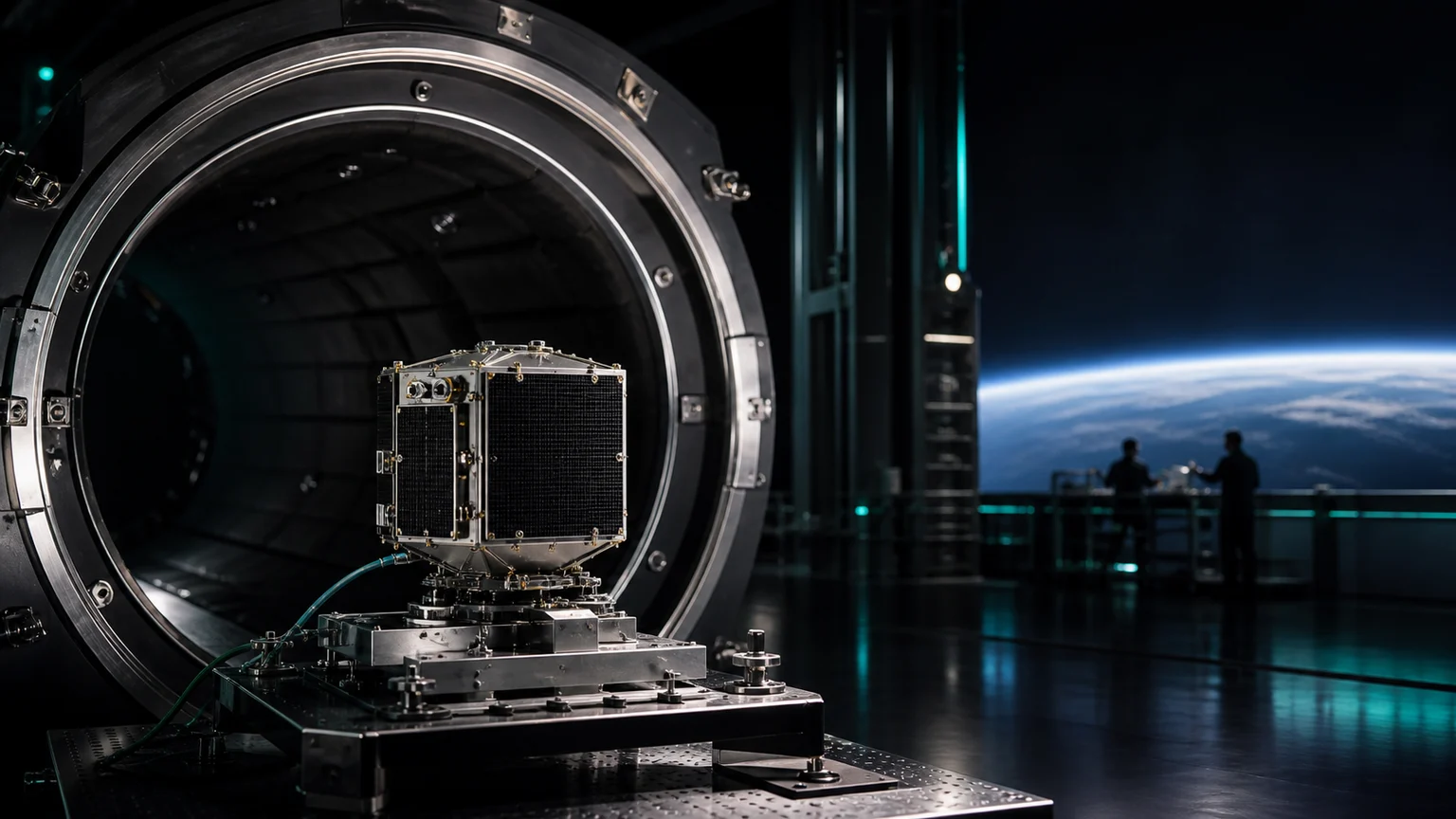
Ground qualification answers whether a defined product meets specified requirements under controlled test conditions. In-orbit validation answers how that controlled configuration behaves within a real spacecraft, mission environment and operating sequence.
The strongest case carries evidence from one stage into the next. Test reports establish what was verified on the ground, while flight telemetry and operational records show what happened after integration and launch. Neither label is useful without the configuration, conditions and criteria behind it.
This distinction matters when a team is deciding whether existing evidence is enough for adoption, or whether a focused In-Orbit Demonstration and Validation campaign, usually shortened to IOD/IOV, would close a remaining gap.
What ground qualification establishes
Qualification is part of a wider verification programme. The ECSS verification standard sets a process for showing that a space product meets its requirements, while the ECSS testing standard covers ground testing of qualification, acceptance and protoflight models before launch.
A ground campaign can create objective evidence that a defined article meets selected functional, performance and environmental requirements. Depending on the mission and technology, that work may include:
- functional and performance tests against allocated requirements;
- vibration or other mechanical testing derived from the launch environment;
- thermal-vacuum, usually called TVAC, and thermal-cycling tests;
- electromagnetic compatibility and interference assessment;
- software, fault-response and end-to-end data-flow testing;
- inspections, analysis and materials evidence alongside physical tests.
The list is illustrative. Projects derive the actual campaign from their requirements, mission environment, verification strategy and risk. NASA-STD-7002, for example, provides a basis for developing NASA payload test programmes and allows tailoring for operating environments. It is not a universal recipe for every commercial payload.
TVAC, vibration and EMC each have a defined job
TVAC testing examines the article under low pressure and controlled thermal conditions. The evidence is meaningful when the chamber profile, article configuration, operating modes, instrumentation and pass criteria are recorded.
Vibration testing addresses the mechanical environment associated with launch and handling. The result supports the exact article, mounting arrangement, configuration and test input that were assessed. A different mounting path or a late mass change can alter that conclusion.
EMC work checks whether equipment can operate within its electromagnetic environment without causing unacceptable effects elsewhere. The ECSS electromagnetic compatibility standard combines system requirements, verification planning and equipment-level test methods, with tailoring for the project.
These activities can provide strong pre-flight evidence. Their value comes from traceability, not from the test name on a certificate.
Why configuration controls the claim
Every qualification result has a boundary. A reviewer needs to know which hardware, firmware and software were tested, how the article relates to the flight unit, which interfaces were active and whether anomalies or deviations were closed.
Changes after a test can affect that boundary. A replacement component, new software build, different connector, altered thermal path or revised operating mode may be covered through analysis and targeted retesting, or it may require a larger verification update. The answer depends on the change and the requirement at risk.
A useful evidence trail therefore connects:
- the requirement being verified;
- the article and configuration tested;
- the procedure, conditions and instrumentation;
- the recorded result and any anomaly;
- the accepted closure and the final flight configuration.
That chain lets a later mission or buyer understand what the ground campaign established, and what remains open.
What operation in orbit adds
Ground facilities reproduce selected conditions. A flight places the technology inside the actual mission system, where interfaces, operations and environmental effects occur together over time.
In-orbit evidence can show:
- whether commissioning and planned operating modes work with the spacecraft;
- how power, thermal, data and timing interactions behave during real operations;
- whether commands, telemetry and recovery paths remain usable in the mission context;
- how performance changes across relevant exposure, duty cycles and operational events;
- which anomalies appear, how the team responds and whether the technology returns to an accepted state;
- whether the delivered data answer the demonstration objective.
The European Commission’s IOD/IOV programme includes aggregation, launch and operations because useful flight evidence depends on more than transport to orbit. ESA’s GSTP Element 3: Fly likewise connects accommodation, mission phases and commissioning to technology demonstration.
Flight still needs a precise question. A launch, power-on event or isolated output may be a useful milestone, but it does not establish every performance or reliability claim a future use could require.
Ground evidence remains part of an IOD campaign
An IOD mission does not replace engineering discipline before launch. Payload integration depends on verified interfaces, known hazards, controlled software and enough environmental evidence to support the combined mission.
The two stages should share one evidence plan:
| Evidence stage | Question it helps answer |
|---|---|
| Ground verification | Does this configuration meet the agreed pre-flight requirements? |
| Integration verification | Does the payload work correctly with the spacecraft and mission interfaces? |
| In-orbit demonstration | Does the technology perform the defined function in the real mission context? |
| Evidence review | What conclusion can a buyer or later mission draw, and where does it stop? |
This continuity prevents a common failure: collecting large amounts of test and flight data without linking them to the decision the mission was meant to support.
When an in-orbit demonstration is useful
An IOD campaign can be a sensible next step when an important uncertainty is hard to close on the ground, when integrated operation creates the main risk, or when a future customer requires flight evidence for a defined configuration and use.
It may be unnecessary when existing heritage is relevant, the change from a proven design is well understood, and qualification or similarity evidence already supports the decision. A mission-fit review should test that case before a team commits to another flight.
For technologies that do need evidence from orbit, the useful starting point is the adoption question: what decision should the flight result make possible? That answer shapes the configuration, mission environment, operating plan, measurements and report.
SATELYX provides IOD as a Service through shared missions. As an Agile Prime for responsive space, SATELYX takes responsibility for the mission, integration, operations and evidence delivery for accepted technologies. Ground testing remains part of the payload’s verification path, with test responsibilities and facilities agreed case by case in the mission plan.
Read the IOD and flight-heritage FAQ for concise definitions, or review the shared IOD mission route to see how mission fit, integration, operations and evidence connect. Teams preparing for a technical discussion can use the payload-readiness guide to assemble the first evidence and interface package.
Frequently Asked Questions
Is ground qualification the same as in-orbit validation?
Do TVAC and vibration tests prove that a payload will work in orbit?
Does every space technology need an in-orbit demonstration?
Can SATELYX perform a payload's ground qualification?
Does Your Space Technology Need Flight Evidence?
Start with a mission-fit review for the software or hardware you need to prove in orbit.
Request a mission review